


Best Refrigerated Worktops: Chill vs Freeze vs Dual
The best refrigerated worktop is the one whose temperature mode matches what sits in it. C…
 16:17
Senlis Technical Team | Qingdao Senlis Import and Export Co., Ltd. | Published: November 5, 2026
The best refrigerated worktop is the one whose temperature mode matches what sits in it. Chill worktops (2–8 °C) suit prepped produce, dairy and proteins for the shift; freeze worktops suit frozen stock at the station; dual-temperature units suit compact lines needing both. All six Senlis models share an 1800×600×800 mm cabinet.
“Best” in this guide means best fit for a use case, not a ranking. A freeze worktop is the wrong purchase for a salad station no matter how well it is built, and a chill worktop cannot hold frozen fries.
Five checkable factors separate one worktop from another:
The first one decides most purchases. The other four decide whether the unit performs in a specific kitchen and clears import requirements in a specific country.
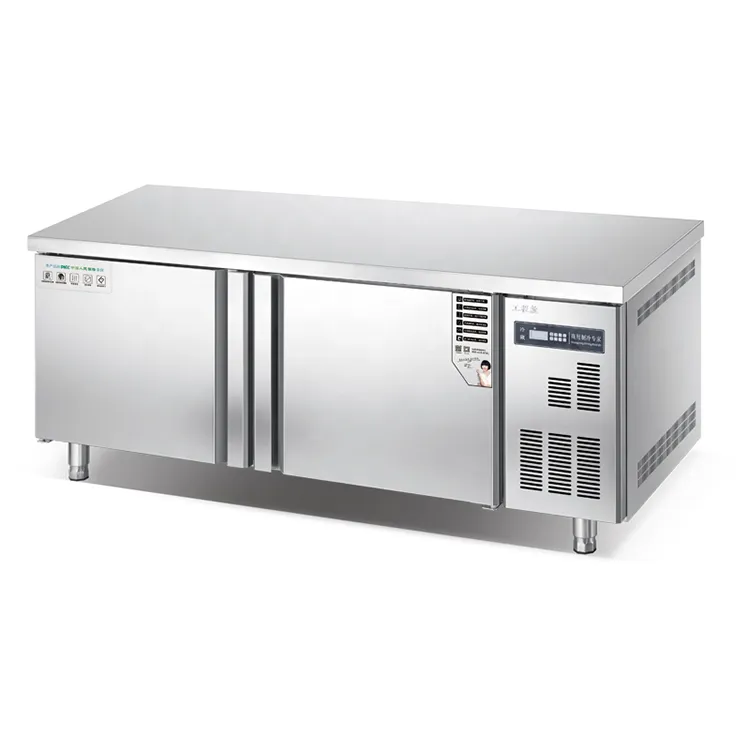
| Chill | Freeze | Dual-temperature | |
| GF series model (copper tube + air-cooled) | SLS-GFC01 | SLS-GFD01 | SLS-GFS01 |
| GZ series model (copper tube cooling) | SLS-GZC01 | SLS-GZD01 | SLS-GZS01 |
| Catalog temperature | 2–8 °C | −15 to 0 °C or −18 to 0 °C, by model | Chill zone + freeze zone; confirm each zone’s range at quotation |
| What it holds | Prepped vegetables, sauces, dairy, portioned proteins | Frozen portions, frozen sides, frozen dough | A shift’s working stock of both |
| Frozen capacity | None | Full cabinet | Part of the cabinet |
| Best-fit station | Cold prep, sandwich and salad lines | Fry and grill stations working from frozen | Compact stations, small kitchens, QSR units with limited line length |
| Main buying risk | Being asked to act as freezer overflow | Freeze floor too high for the customer’s storage target | Frozen zone too small for peak service |
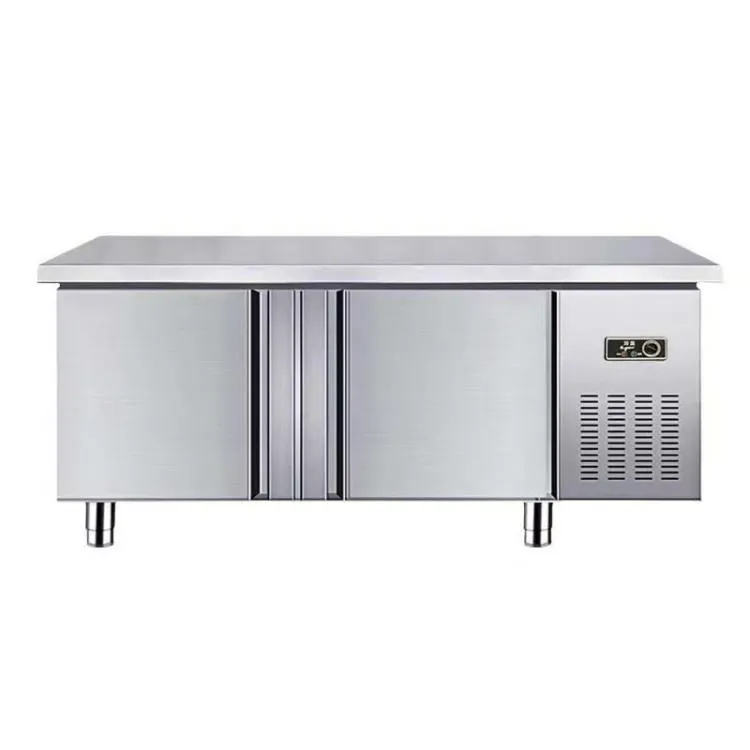
Shared across all six: 1800×600×800 mm (≈ 70.9 × 23.6 × 31.5 in) · thickened stainless steel worktop · auto defrost · digital control panel · CE, RoHS and ISO 9001 certification.
The freeze-floor row is where buyers most often get caught. The line lists two different lower limits. If a customer’s frozen storage target is −18 °C, a unit built to −15 °C will not meet it, so name the target in your inquiry and get the confirmed range for the exact model in writing.
Once the temperature mode is chosen, the series decides how the cold reaches the food.
| Factor | GF series (copper tube + air-cooled) | GZ series (copper tube cooling) |
| Air movement | Fan circulates chilled air | No fan-forced circulation described in catalog |
| Temperature evenness | Generally more uniform across the compartment | More variation between coldest and warmest points |
| Recovery after door opening | Generally faster | Generally slower |
| Effect on uncovered food | Moving air dries exposed surfaces faster | Less drying of open containers |
| Stronger fit | High-turnover stations with frequent door openings | Longer holding of prepped items in open pans |
For most busy QSR and restaurant lines, the GF series is the more forgiving choice. The GZ series makes sense where doors stay closed longer and moisture loss from prepped food is the bigger concern.
| Scenario | Recommended mode | Why |
| Sandwich or salad prep line | Chill | Everything held is chilled; full cabinet volume for ingredients |
| Fry station using frozen portions | Freeze | Frozen stock stays within arm’s reach of the fryer |
| Single compact station serving a small menu | Dual | One unit covers both temperatures in 1800 mm of line |
| Large kitchen with high frozen volume | Chill + separate freeze worktop | A dual unit’s frozen zone runs out during peak service |
| Burger or grill station with frozen patties and chilled toppings | Dual, or chill + freeze side by side if line length allows | Depends on frozen volume per shift |
Compared with prep tables that carry a refrigerated ingredient rail on top, a flat worktop gives a clear stainless steel surface for assembly and portioning, but keeps all cold storage below the counter. Kitchens that need toppings visible and open during service usually pair a worktop with a separate topping solution rather than expecting the worktop to do both.
For an importer stocking a worktop line, the six models have one practical advantage: identical external dimensions. Showroom layouts, container loading plans and customer site surveys work the same way for every model in the range. Units ship packed in a 5-layer carton or on a pallet.
A workable starting range for most foodservice distributors is one chill, one freeze and one dual model from the same series, then adding the other series once customer feedback shows whether your market leans toward air-cooled or copper tube cooling. Production runs at more than 400 units per day, so mixed-model orders across temperature modes are a capacity question to settle in quotation, not a limitation of the line.
All six models accept the same OEM/ODM options: exterior color and branding, internal layout, refrigerant (R290, R134a or R600), voltage (110 V, 220 V or 380 V), plug standard (US, EU or UK), and packaging and manual language.
Buying dual-temperature as the default. A combo looks like the safe all-rounder, but its frozen zone is a fraction of a dedicated freeze cabinet. Customers with heavy frozen volume end up walking to a back-of-house freezer mid-service.
Treating every freeze worktop as −18 °C. The catalog lists −15 to 0 °C and −18 to 0 °C ranges. These are different products for buyers with a −18 °C storage requirement.
Ignoring certification fit for the destination. The line is certified to CE, RoHS and ISO 9001. Buyers in North America commonly reference NSF International and UL standards for foodservice equipment, and Senlis has not documented NSF or UL listings. Commercial refrigerating appliances also fall under the safety requirements of IEC 60335-2-89, which is relevant when specifying a flammable refrigerant such as R290. Check your market’s requirements before choosing a refrigerant and before quoting a tender.
| Mode | Strengths | Limitations |
| Chill | Full cabinet at 2–8 °C; simplest to specify | No frozen storage at the station |
| Freeze | Full cabinet of frozen stock under the prep surface | Two possible freeze floors; must confirm per model |
| Dual | Both temperatures in 1800 mm of line | Smaller frozen capacity; per-zone ranges and volume split not published |
Across all three modes, internal dimensions, net volume, power draw and noise level are not yet published. Request them with your quotation rather than estimating from the cabinet size.
Senlis does not publish prices, MOQs or price ranges for refrigerated worktops. Pricing is quoted per project. Request a quote for your model, quantity, and destination market, and state the temperature mode, freeze target and voltage so the quote matches your configuration.
Q: Which refrigerated worktop type is best for a restaurant?
A: It depends on the station. Chill models suit cold prep lines, freeze models suit fry and grill stations working from frozen, and dual-temperature models suit compact stations needing both.
Q: What is the difference between the GF and GZ series?
A: GF models use copper tube + air-cooled refrigeration with fan circulation. GZ models use copper tube cooling. Both series share the same 1800×600×800 mm cabinet.
Q: What temperatures do Senlis refrigerated worktops reach?
A: Chill models are listed at 2–8 °C. Freeze models are listed at −15 to 0 °C or −18 to 0 °C, depending on model.
Q: Are all Senlis refrigerated worktops the same size?
A: Yes. All six catalog models measure 1800×600×800 mm. Other sizes are available as custom OEM orders.
Q: Can I order worktops with my own brand?
A: Yes. Exterior color, branding, internal layout, refrigerant, voltage, plug standard, packaging and manual language are all OEM/ODM options.
Q: Do Senlis worktops have NSF or UL certification?
A: Senlis’s documented certifications are CE, RoHS and ISO 9001. Confirm market-specific listing requirements before ordering for North America.
2026-11
The best refrigerated worktop is the one whose temperature mode matches what sits in it. C…

2026-11
A worktop refrigerator freezer combo is a counter-height prep unit with a refrigerated sec…

We will reply you within 24 hours. If for urgent case, please add WhatsApp/WeChat: +8617806295551. Or call +8617806295551/+8617660987312 directly.
*We respect your confidentiality and all information are protected.
We will only use your information to respond to your inquiry and will never send unsolicited emails or promotional messages.