





How to Choose a Commercial Back Bar Cooler or Glass Door Beverage Refrigerator
Compare bar coolers, back bar and undercounter designs, beer temperature needs, glass door…
 09:38
09:38 Senlis Technical Team | Qingdao Senlis Import and Export Co., Ltd., commercial refrigeration manufacturer since 2003 | Published 27 August 2026
Set a مبرد البيرة التجاري to 3–4 °C (37–39 °F). The cabinet’s usable band is 2–10 °C, but the setpoint is not the serving temperature: liquid in a bottle lags cabinet air by hours, and door traffic pushes shelf temperature up long before the controller reacts.
Serving ranges below reflect conventional trade practice as of 27 August 2026; cabinet specifications reflect the Senlis bar beer cooler line as currently published. Serving convention shifts with style trends, and the equipment band does not.
Most temperature arguments about beer happen because two people are discussing different measurements.
Setpoint is what you type into the controller. Cabinet air temperature is what the sensor reads, which varies by shelf position. Product core temperature is what the customer drinks, and it lags cabinet air by two to six hours after a warm restock. Serving temperature is the range a given style tastes right at, which for most of the beer catalogue sits above any of the previous three.
A consumer post arguing that stout belongs at 12 °C is not wrong about the beer. It is wrong about the cabinet, because no commercial bar cooler holding pilsner alongside stout can be at 12 °C.
| الطراز | Serving range (°C) | Serving range (°F) | Straight from a 3 °C cabinet? |
| Pale lager, pilsner, helles | 3–5 | 37–41 | نعم |
| Wheat beer, witbier | 4–7 | 39–45 | نعم |
| Pale ale, IPA | 7–10 | 45–50 | Needs 10–20 min out |
| Amber ale, bitter | 8–12 | 46–54 | Needs time out |
| Stout, porter | 8–13 | 46–55 | Needs time out |
| Barrel-aged, imperial, strong ale | 12–14 | 54–57 | Store separately or serve at cellar temperature |
Conversion for anyone working across both scales: 2 °C = 36 °F, 4 °C = 39 °F, 7 °C = 45 °F, 10 °C = 50 °F.
The practical consequence is that a single-cabinet bar sets the thermostat for its volume seller and manages everything else by pour timing. Bars with meaningful craft volume run a second cabinet at the upper end of the 2–10 °C band rather than compromising the main one.
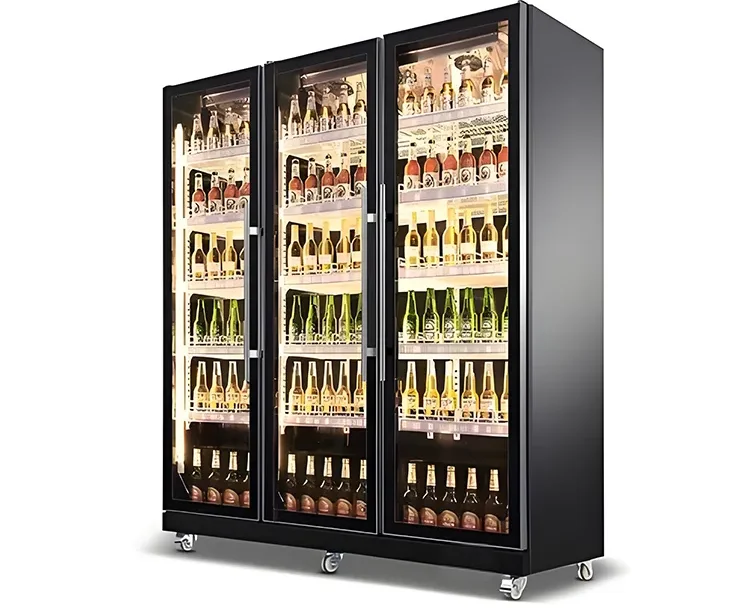
The most common error in a busy venue: staff notice product feels warm at 22:00, so they drop the setpoint to 2 °C. Three things follow.
The evaporator runs longer per cycle, which increases frost load and forces more frequent defrost, which itself pushes temperature back up. Bottled beer nearest the coldest air path can drop below its freezing point — beer freezes around −2 °C depending on ABV, and a bottle that freezes at the neck will gush or crack. And the warm shelf does not actually get colder, because the problem was never the setpoint.
The problem is recovery.
A service bar can open a cooler door 200 to 400 times across a busy evening. Every opening exchanges cold cabinet air for room air at 24–28 °C carrying its own moisture load. The controller sees this, calls for cooling, and the cabinet returns toward setpoint — but the rate at which it returns is a design property, not a setting.
This is the reason مبردات بيرة البار use air-cooled frost-free systems rather than static cooling. Circulated air moves heat off the product surface and back to the evaporator much faster than still air does, and it stops frost building on the evaporator fins where it would insulate the coil and slow recovery further. Compared with the domestic-style glass-door refrigerators sometimes pressed into commercial bar service, the difference shows up not in the setpoint the two cabinets can display, but in how long each takes to get back there after the fortieth door opening of the hour.
Three loading habits cost more recovery time than any thermostat adjustment:
Do this once, properly, and stop guessing. It takes one trading day plus an overnight.
Record the results somewhere the next manager will find them. Most cabinets get re-guessed every time staff turn over.
Any cooler operating below the dew point of the air entering it accumulates moisture on the evaporator, which freezes. Removing that frost requires the evaporator to rise above 0 °C for a period, during which the cabinet warms.
Frost-free air-cooled systems manage this on an automatic cycle, and the resulting swing is usually contained within the operating band. Two situations widen it: a cabinet in a humid, unconditioned venue accumulates frost faster and defrosts more often, and a cabinet whose airflow is blocked by loading builds frost unevenly. Both show up in step 7 above.
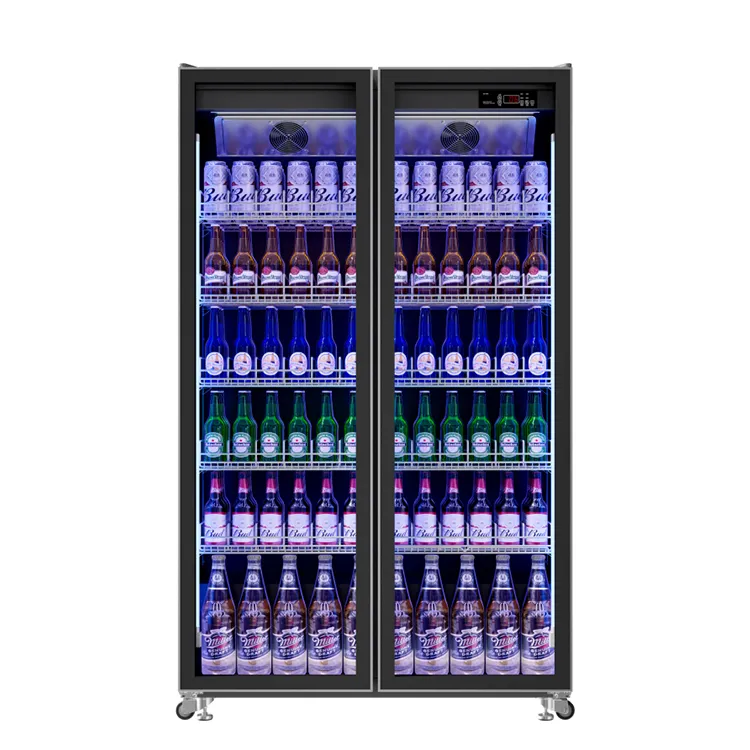
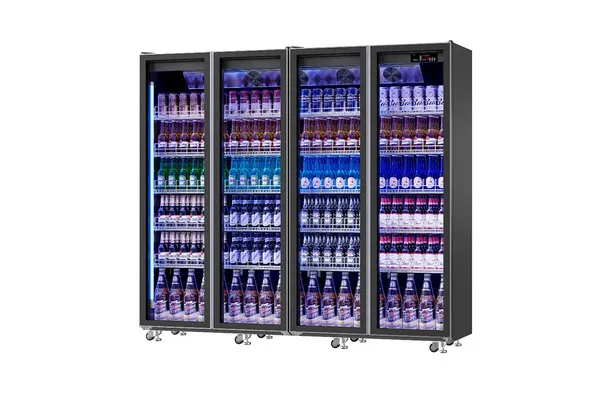
Both models operate across 2–10 °C with air-cooled frost-free cooling, 600 mm cabinet depth, adjustable shelving, three-colour LED strip lighting, optional heavy-duty casters, and CE, RoHS and ISO 9001 certification.
The difference between them is glass, and it is a temperature-adjacent decision. SLS-PF02 uses coated anti-fog tempered glass, which changes how condensate wets the outer pane. SLS-PFG02 uses heated-wire demisting glass rated for 100% defogging, which holds the outer pane above dew point and draws power continuously to do it. In a venue at 28 °C and high humidity, the coated version will still show condensation on the outside of the glass at a 3 °C setpoint, because outer glass temperature falls below the room’s dew point regardless of what the controller is set to. That is a room condition, not a fault.
Across the wider line, cabinet widths run 660 mm to 2225 mm at heights of 1830 mm or 2010 mm, and door counts from one to four. Voltage (110 V / 220 V / 380 V), plug standard, refrigerant type, shelf layout, exterior finish and branding are OEM options. Confirm the width and door split for a specific model code on the factory drawing before planning a back-bar run.
IEC 60335-2-89 is the safety standard covering commercial refrigerating appliances, including the charge limits that apply to flammable natural refrigerants — the reason a cabinet of a given volume carries the compressor and charge it does.
The EU Ecodesign and Energy Labelling Regulations for professional refrigeration (Regulation 2015/1095 and Regulation 2019/2018) define the test conditions under which a professional cabinet’s temperature and energy performance is declared. Those conditions specify a climate class, which is why a cabinet performing to spec in a temperate test chamber may not hold the same band in an unconditioned tropical bar. Ask which climate class a unit was tested to before specifying for a hot, humid market.
ASHRAE publishes the refrigerant safety classifications that both of the above reference.
A lower setpoint costs energy continuously; a slow-recovering cabinet costs product quality at peak. Neither cost appears on a datasheet, which is why the verification steps above are worth a day.
يتم تحديد الأسعار حسب كل مشروع على حدة — يرجى طلب عرض أسعار وفقًا للنموذج والكمية والسوق المستهدفة.
A: 3–4 °C (37–39 °F) suits most bars selling primarily lager and wheat beer. The cabinet band is 2–10 °C, so ale-led venues run warmer.
A: It is within the cabinet’s range but leaves little margin. Beer freezes around −2 °C depending on ABV, and bottles sitting directly in the coldest air path can reach that.
A: The display reads air at the sensor. Product core temperature lags, particularly after a room-temperature restock, and front-top shelves near the door run warmest. Measure a bottle, not the air.
A: Recovery depends on the cooling system, loading and room conditions rather than on the setpoint. Air-cooled frost-free circulation recovers faster than static cooling, and a blocked air path slows any system.
A: They can, at a lager-appropriate setpoint, with stout allowed 10–20 minutes out of the cabinet before pouring. Venues with substantial ale volume use a second cabinet at the upper end of the range instead.
A: Not the setpoint. Heated demisting glass adds a small continuous heat input at the door, which the system accounts for, and it is what keeps the pane clear in humid rooms.
One number sits upstream of everything above and rarely gets checked: the temperature of the storeroom the cabinet is restocked from. Product arriving at 25 °C rather than 15 °C roughly doubles the thermal load each restock places on the cabinet, and a cool store room does more for peak-hour product temperature than any thermostat adjustment.
2026-10
Compare bar coolers, back bar and undercounter designs, beer temperature needs, glass door…
2026-09
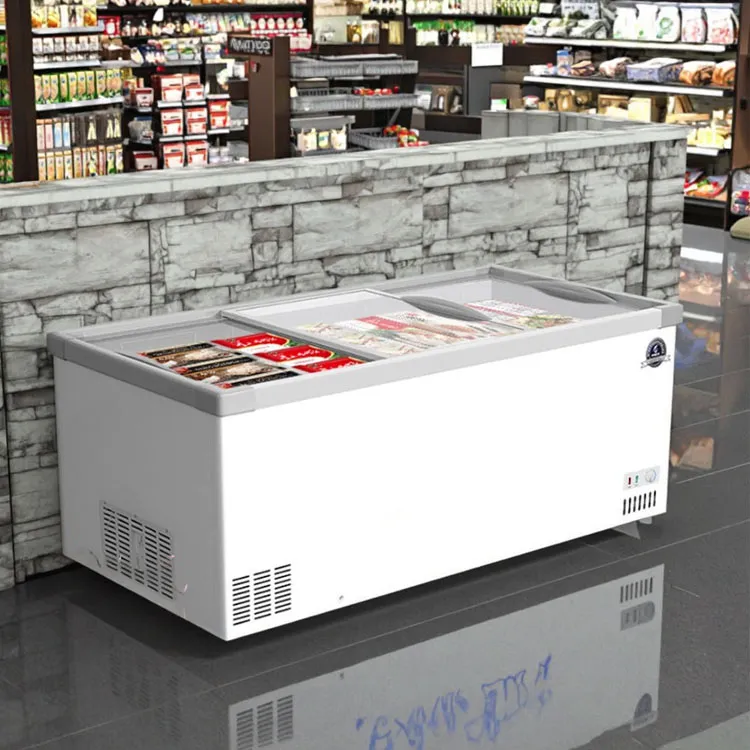
The SLS-ZD1860 Combo Island Cabinet measures 1860 × 810 × 800 mm and lists a temperature r…
سنرد عليك في غضون 24 ساعة. إذا كان للحالة العاجلة، يرجى إضافة واتساب/وي شات: +8617806295551. أو اتصل على +8617806295551/+8617660987312 مباشرة.
*نحن نحترم سريتك وجميع معلوماتك محمية.
لن نستخدم معلوماتك إلا للرد على استفسارك ولن نرسل أبداً رسائل بريد إلكتروني غير مرغوب فيها أو رسائل ترويجية.