






How to Choose a Commercial Back Bar Cooler or Glass Door Beverage Refrigerator
Compare bar coolers, back bar and undercounter designs, beer temperature needs, glass door…

 10:31
10:31 Buying the wrong commercial refrigerator can create slow service, wasted food, high energy bills, and costly downtime. Those problems grow quickly in a busy restaurant, supermarket, or hotel. The solution is to match the refrigerator or freezer to your storage needs, workflow, ambient conditions, and daily commercial use.
When comparing commercial refrigerators for sale, choose by temperature range, usable capacity, reach-in or undercounter design, door type, compressor system, energy efficiency, sanitation, and service access. The best commercial refrigerator is not simply the cheapest model; it is the unit that reliably supports your foodservice operation, product load, kitchen layout, and long-term operating cost.
A search for коммерческие холодильники for sale can return hundreds of models. Some are tall reach-in units. Others are compact undercounter refrigerators, glass-door merchandisers, prep tables, beverage refrigerators, or commercial freezers.
They may all refrigerate products, but they do not serve the same job.
The U.S. Department of Energy’s commercial refrigeration purchasing guidance includes reach-in, roll-in, pass-through, display, merchandiser, undercounter, worktop, bottle cooler, back-bar, and other commercial refrigeration equipment. That range shows why buyers should begin with application rather than price.
Before you shop commercial refrigerators, define:
For B2B procurement, also consider MOQ, packaging, container loading, spare parts, warranty, branding, and repeat-order consistency.
That is especially important for distributors and chains ordering an entire inventory of commercial refrigerators, rather than one fridge.
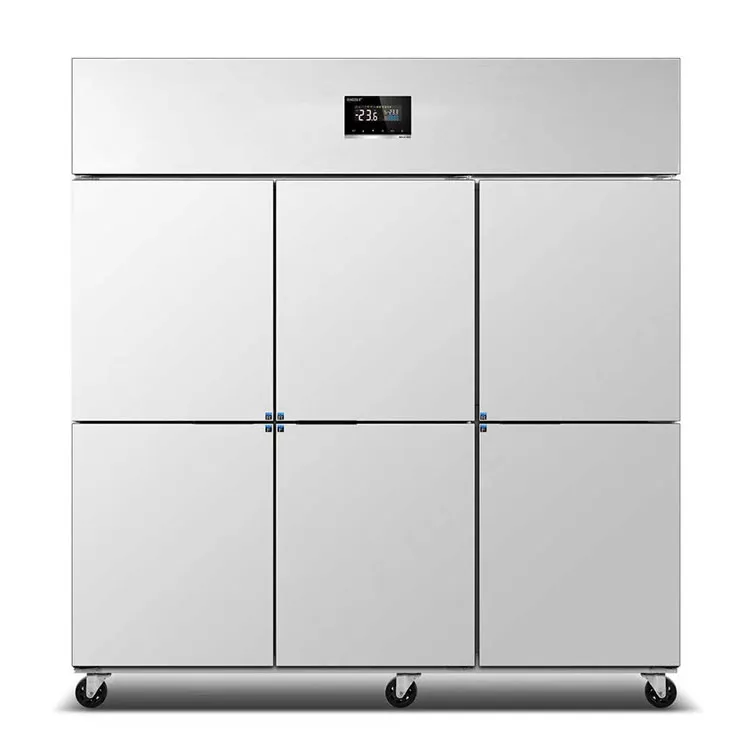
There is no single best коммерческий холодильник for every application. Professional refrigeration falls into several groups, and each solves a different storage or workflow problem.
A reach-in refrigerator is a tall upright cabinet that provides easy access to chilled ingredients. It is common in restaurants, hotels, institutional kitchens, bakeries, cafeterias, and food production areas.
Undercounter refrigerators fit beneath counters and work surfaces. They keep ingredients close to employees and are useful where floor space is limited.
Worktop refrigerators add a durable working surface above refrigerated storage. They support preparation areas where staff need both counter space and chilled ingredients.
A prep table combines refrigerated ingredient storage with a preparation surface or ingredient pan area. A sandwich prep table refrigerator, for example, helps staff prepare sandwiches, salads, pizzas, and quick-service meals.
A merchandiser refrigerator uses glass doors to display cold products to customers. It works especially well in a convenience store, supermarket, café, beverage retailer, or grab-and-go area.
A commercial freezer keeps frozen food at lower temperatures and may use upright, undercounter, display, or chest-style construction.
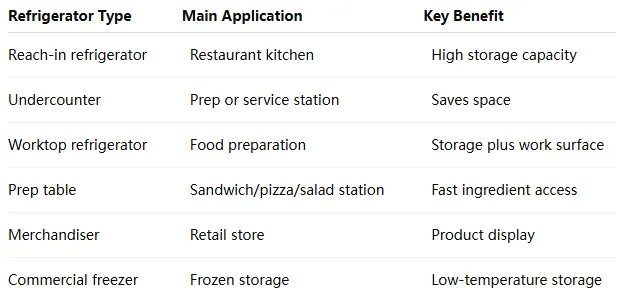
The right range of commercial equipment depends on workflow.
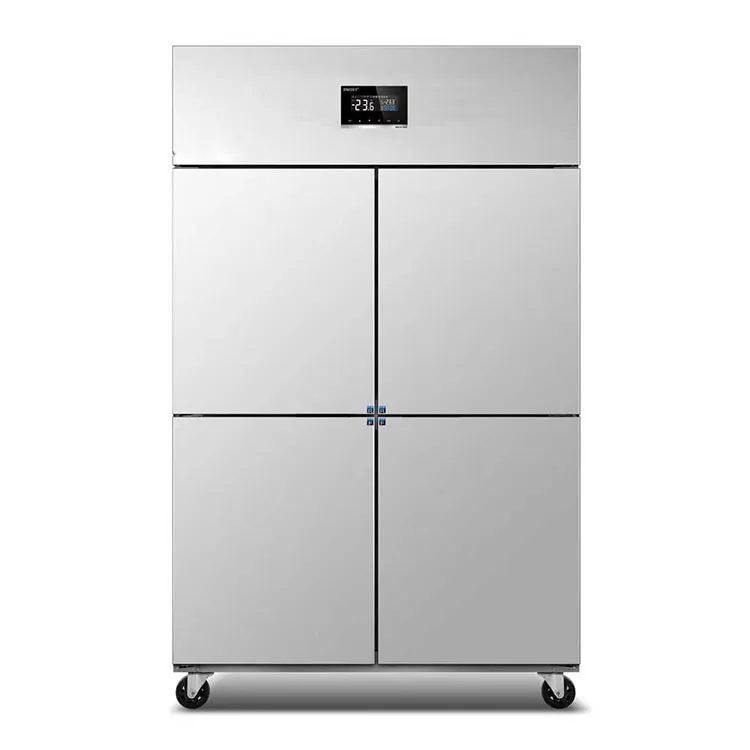
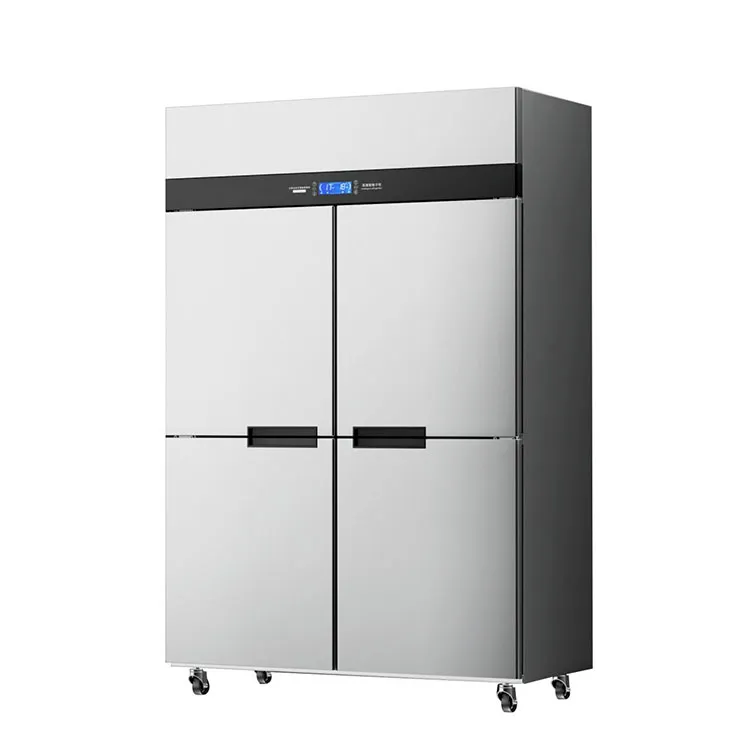
A reach-in refrigerator is one of the most useful pieces of commercial kitchen equipment because it combines large vertical storage with fast staff access.
A typical commercial reach-in may use one, two, or three doors.
К числу типичных областей применения относятся:
A commercial reach-in refrigerator is useful when employees need regular access to ingredients throughout the day.
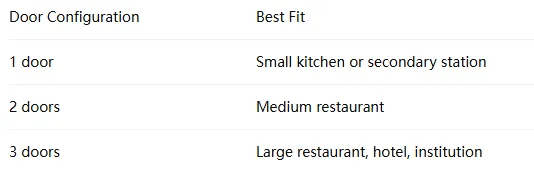
A reach-in upright refrigerator uses vertical space efficiently, but buyers should compare net capacity rather than exterior size alone.
Inside the cabinet, the evaporator, compressor section, shelves, and air passages all reduce usable storage.
A high-quality commercial upright unit should also allow proper airflow around stored food. Packing a cabinet too tightly can create uneven temperatures.
Many buyers purchase reach-in refrigerators and freezers as a matching equipment group.
This can simplify:
For restaurant groups, consistency across several sites can also make maintenance easier.
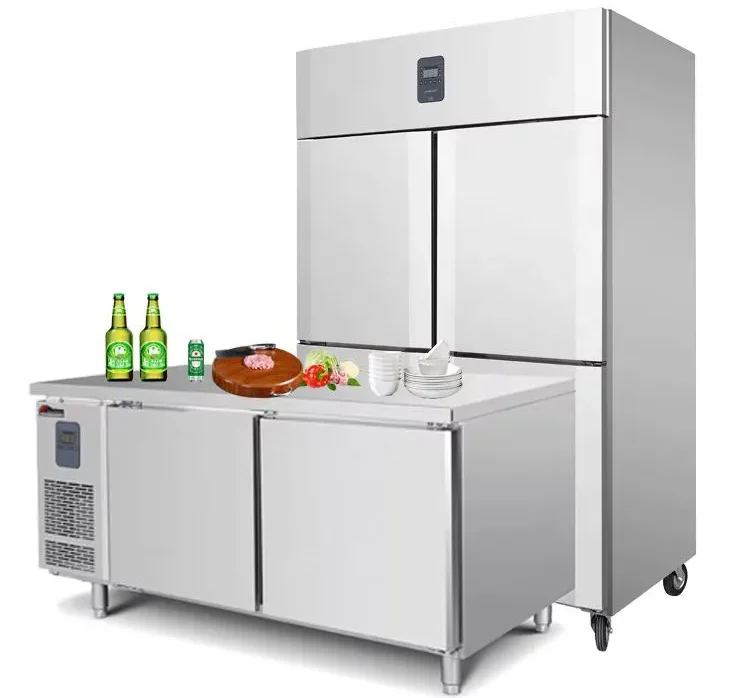
These three products look similar, but their purposes differ.
An undercounter refrigerator mainly provides cold storage underneath an existing counter.
A worktop model adds a usable top surface.
A prep table usually provides quick access to ingredients during assembly or preparation.
An undercounter commercial refrigerator is useful when staff need chilled products close to a service station.
К типичным областям применения относятся:
An undercounter refrigerator with drawers can improve ingredient organization and reduce door-swing problems in narrow aisles.
Worktop refrigerators provide refrigerated storage below a stainless work surface.
This design can help small kitchens use the same footprint for two purposes.
Prep refrigerators support fast food assembly. The top may hold food pans while the lower cabinet stores additional ingredients.
A sandwich prep refrigerator works well for:
The best choice depends on your workflow.
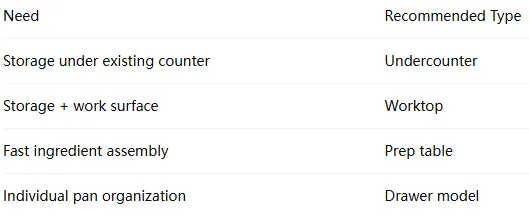
A compact kitchen may use all three across different stations.
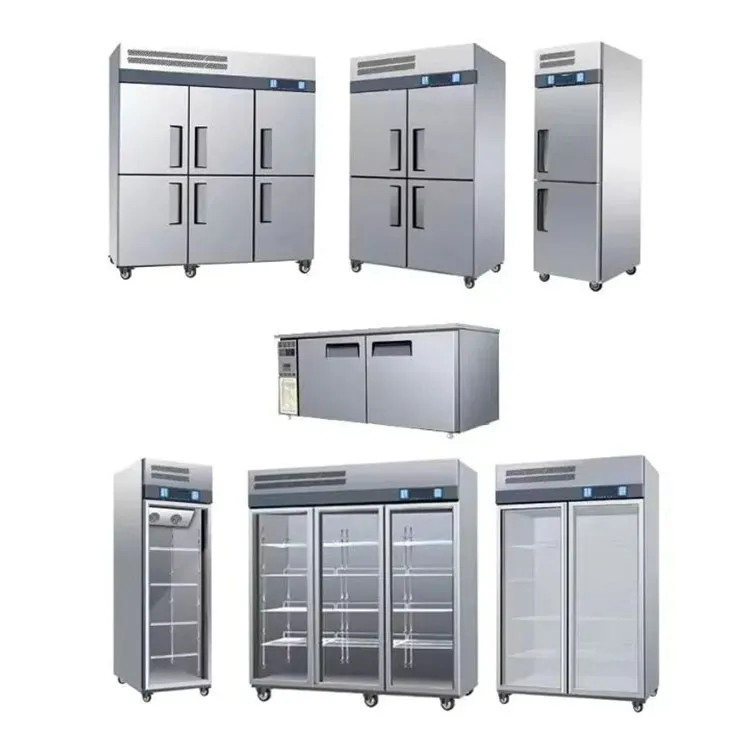
A glass door refrigerator does two jobs.
It keeps products cold and displays them.
That makes glass door refrigerators especially useful in customer-facing areas where seeing the product can encourage a purchase.
Examples include:
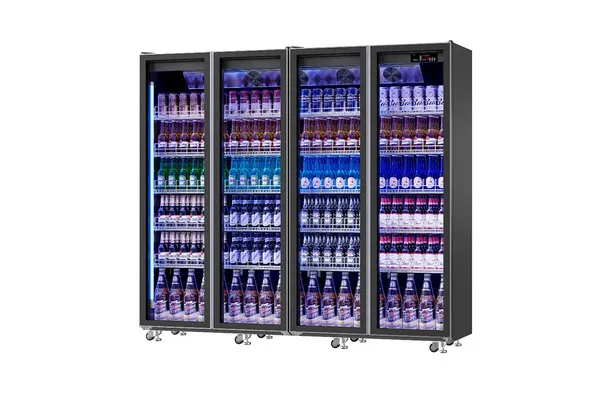
A glass door merchandiser refrigerator lets customers browse bottled drinks, packaged food, dairy products, desserts, or other refrigerated products before opening the cabinet.
A glass door merchandiser may include:
Beverage Refrigerator and Commercial Beverage Applications
A beverage refrigerator is a common merchandiser format.
It may hold:
For commercial beverage retail, product visibility can be nearly as important as refrigeration performance.
A vertical refrigerator merchandiser can use floor space efficiently while showing many SKUs.
Some bars and hospitality projects may instead use a commercial back bar, bottle cooler, or undercounter beverage unit where staff access matters more than customer self-service.
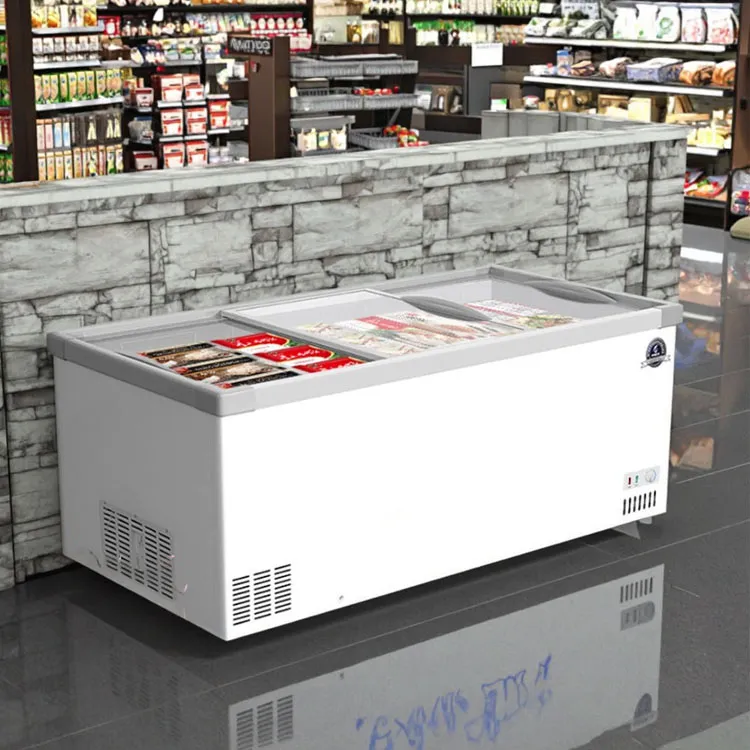
Commercial ice cream display equipment requires freezer temperatures rather than ordinary refrigerator conditions.
Buyers should therefore separate refrigerated merchandisers from frozen display cabinets during sourcing.
A cabinet that looks similar on the outside may have a very different refrigeration system inside.
A refrigerator stores chilled products.
A freezer stores frozen products.
That sounds obvious, but many businesses need both within limited space.
A коммерческий холодильник freezer combo can place refrigerated and frozen storage in one cabinet. This can work well for operations with moderate quantities of both product types.
However, combined units also have tradeoffs:
A dedicated commercial refrigerator and freezer pair may be better when storage volume is high.
Consider a combination unit for:
Choose separate units for:
The correct decision depends on storage needs.
A commercial refrigerator should not be asked to freeze products, while a freezer should not be run unnecessarily warm to serve as a refrigerator.
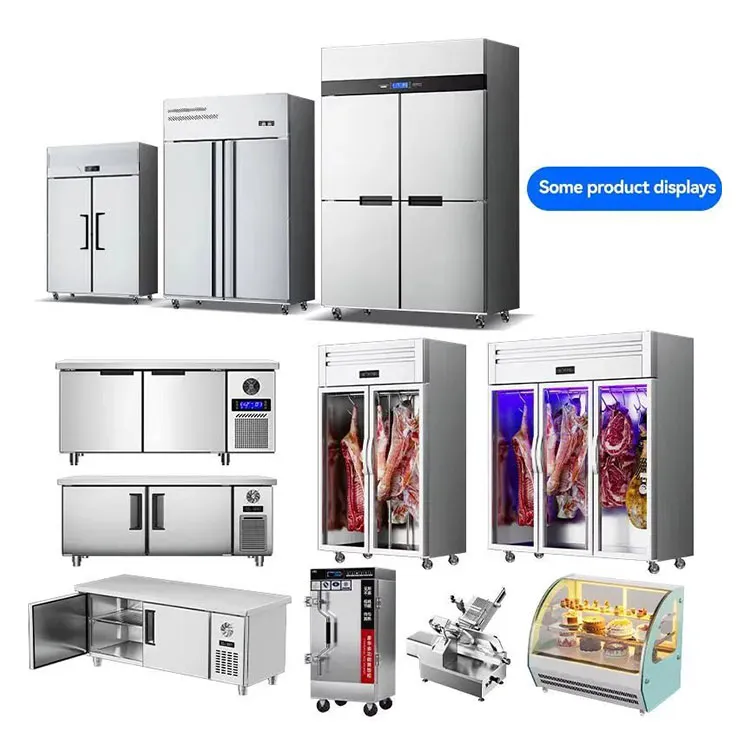
A commercial refrigerator should support the kitchen rather than dominate it.
Measure the available space carefully.
Check:
A tall upright refrigerator uses vertical storage efficiently, while undercounter equipment saves valuable aisle space.
A door коммерческий холодильник may have:
Solid doors suit kitchens where product visibility is not needed.
A commercial glass door configuration works better for retail or inventory visibility.
When choosing a door commercial upright unit, consider how far each door swings into the aisle.
In a busy kitchen, a very wide door can block staff traffic.
Half doors or multiple smaller sections may help in some layouts.
A simple planning rule is:
Required chilled stock = Peak daily usage + safety stock
Do not size the refrigerator only for average demand.
Holiday periods, weekend traffic, hotel events, or peak restaurant service can increase storage needs quickly.
A professional refrigerator works in a harsh environment.
Commercial kitchens expose equipment to:
That is why stainless steel is common in commercial food refrigeration.
A stainless steel commercial refrigerator can provide a durable, smooth, professional surface, but buyers should ask where stainless steel is actually used.
Check the:
Not every cabinet described as stainless steel uses the same material across all surfaces.
The compressor moves refrigerant through the refrigeration system.
However, compressor brand or size alone does not determine performance.
Also evaluate:
A reliable commercial refrigerator depends on all these parts working together.
Stable temperature control is essential.
A refrigerator should maintain suitable product conditions even when:
For B2B buyers, ask the supplier for the tested temperature range and ambient operating conditions.
Do not rely on a catalogue phrase such as “powerful cooling.”
A commercial refrigerator may operate 24 hours every day.
That makes electricity an important part of ownership cost.
ENERGY STAR reports that certified commercial solid-door refrigerators can save around 325 kWh annually, while certified commercial glass-door refrigerators can save around 370 kWh annually compared with standard models under its program assumptions.
For one refrigerator, that is useful.
For 50 or 100 units, the effect becomes much larger.
An energy-efficient commercial refrigeration unit may use:
But actual energy use also depends on:
DOE recommends maintaining condenser coils, gaskets, and door closers because dirty heat exchangers and leaking doors can make refrigeration equipment work harder.
Different industries need different commercial refrigeration equipment.
Commercial refrigerators for restaurants normally prioritize:
Common choices include reach-ins, undercounter units, prep refrigerators, and freezers.
When buyers shop commercial refrigerators for restaurants, workflow should guide the decision.
Hotels may require:
Retail applications focus more heavily on:
A merchandiser display refrigerator can support chilled product sales while a commercial freezer handles ice cream and frozen food.
A convenience store may use:
These businesses may need:
Searches for commercial refrigerator brands are common.
However, brand recognition alone does not tell you whether a refrigerator fits your business.
A procurement team should compare commercial refrigerator options using measurable specifications.
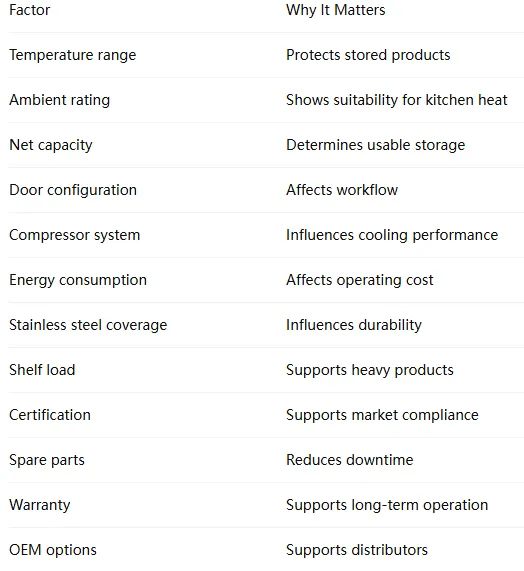
A modern commercial refrigerator should be evaluated as a system.
Do not choose only because a product page says:
Those phrases need evidence.
Ask for:
For importers and distributors, a supplier’s ability to manufacture the same specification consistently across repeat orders can be just as important as the first sample.
A strong B2B inquiry gives the manufacturer enough information to recommend the correct refrigeration equipment.
At Senlisi, we recommend including:
Technical Questions
Спросите:
Commercial Questions
Спросите:
These questions turn a general inquiry into a production-ready specification.
Сенлиси is a global manufacturer and exporter of commercial refrigeration equipment based in Qingdao, China.
We provide a range of commercial refrigerators, freezers, display cabinets, and customized refrigeration solutions for global professional markets.
Our customers include:
Instead of treating every inquiry as the same refrigerator request, we look at the application.
A supermarket buyer may need a commercial merchandiser with glass doors.
A restaurant may need a reach-in refrigerator and freezer.
A café may need an undercounter refrigerator.
A deli may need sandwich prep refrigeration.
A beverage retailer may need a large commercial beverage refrigerator.
That application-first approach helps B2B buyers avoid overbuying or choosing the wrong cabinet.
Depending on the product and project requirements, commercial refrigeration sourcing may involve:
For distributors, contractors, restaurant chains, retailers, and project buyers, this can make the difference between buying isolated equipment and building a consistent refrigeration program.
The best commercial refrigerator depends on kitchen size, storage needs, product type, door-opening frequency, ambient temperature, and workflow. Reach-in refrigerators suit bulk chilled storage, while undercounter and prep refrigerators keep ingredients closer to staff.
A commercial refrigerator is designed around professional operating conditions such as frequent access, larger product loads, foodservice workflows, and commercial sanitation requirements. Residential equipment serves a different use case and is covered by different efficiency requirements.
Choose a glass door commercial refrigerator when product visibility or merchandising matters. Choose solid doors when storage efficiency and back-of-house use matter more than display. Retail stores often prefer glass, while restaurant kitchens commonly use solid-door units.
Estimate your peak stock requirement, available floor space, door clearance, and replenishment frequency. A single-door unit may suit a smaller operation, while a two- or three-door commercial reach-in can support larger kitchens.
For markets where ENERGY STAR applies, certified models can reduce energy use compared with standard models. ENERGY STAR reports annual savings for eligible solid-door and glass-door commercial refrigerator configurations. Buyers should compare the exact model and test data rather than assuming every commercial refrigerator qualifies.
Send the destination country, application, dimensions, door configuration, required temperature, ambient conditions, voltage, order quantity, certification requirements, and any OEM or branding needs. This allows a more accurate recommendation and quotation.
2026-10
Compare bar coolers, back bar and undercounter designs, beer temperature needs, glass door…
2026-09
The SLS-ZD1860 Combo Island Cabinet measures 1860 × 810 × 800 mm and lists a temperature r…
Мы ответим вам в течение 24 часов. Если для срочного случая, пожалуйста, добавьте WhatsApp/WeChat: +8617806295551. Или позвоните по телефону +8617806295551/+8617660987312.
*Мы уважаем вашу конфиденциальность и защищаем всю информацию.
Мы будем использовать вашу информацию только для ответа на ваш запрос и никогда не будем отправлять нежелательные электронные письма или рекламные сообщения.