






How to Choose a Commercial Back Bar Cooler or Glass Door Beverage Refrigerator
Compare bar coolers, back bar and undercounter designs, beer temperature needs, glass door…
 09:40
09:40 Senlis Technical Team | Qingdao Senlis Import and Export Co., Ltd., commercial refrigeration manufacturer since 2003 | Published 28 August 2026
A commercial refrigerator lasts 10 to 15 years in normal service, and the gap between those two numbers is decided at the design stage rather than by maintenance. Door seals, condenser access, shelf load rating and refrigerant choice determine whether a cabinet reaches the top of that range.
Specifications quoted below reflect the Senlis commercial refrigerator line as published on 28 August 2026. Regulatory context around refrigerants moves faster than hardware does, so the servicing section is the part of this article most worth re-checking against your destination market.
“Lifespan” hides three separate events, and buyers argue past each other because they mean different ones.
Mechanical end of life is the point where a core component fails beyond economic repair — usually the compressor, occasionally the cabinet structure itself.
Economic end of life arrives earlier. It is the point where the next repair costs more than the remaining value justifies, which for most operators means the second or third significant callout in a single year.
Serviceable end of life is the one sourcing buyers underestimate. A cabinet is finished when the parts it needs are no longer obtainable in its market, or when its refrigerant has been phased down far enough that a technician will not or cannot recharge it. Hardware can be sound and the unit still dead.
Most replacement decisions are triggered by the second, and most surprises come from the third.
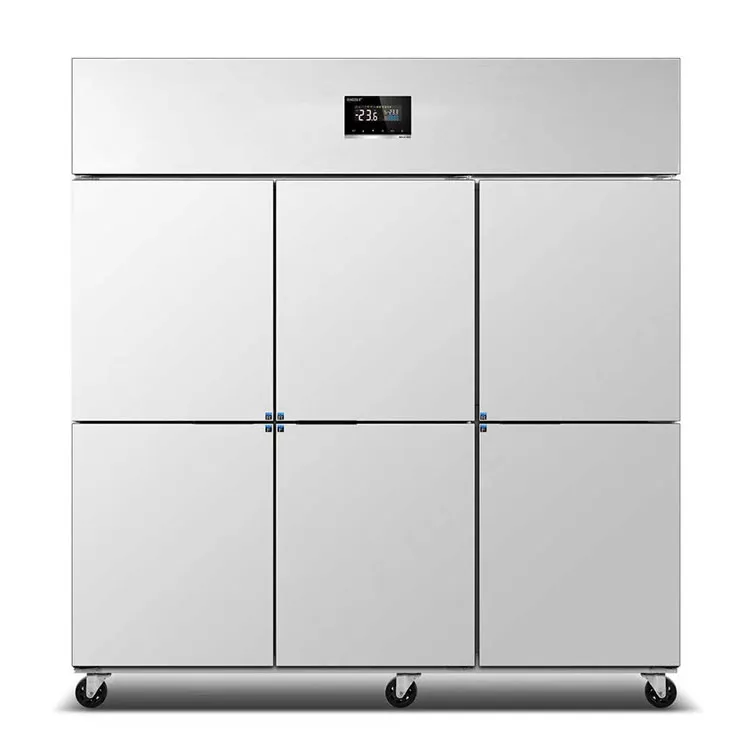
The band repeated across US foodservice-equipment guides and repair-service blogs is not a specification. No standard defines it, no manufacturer warrants it, and it is derived from the mixed experience of operators running very different cabinets in very different rooms.
It is still a useful anchor, because the spread within it is real and predictable. Two cabinets of identical internal volume, bought the same week for the same kitchen, routinely diverge by five years. The divergence is not luck, and it is mostly not the cleaning schedule either. It is build.
Ordered by how often it ends a cabinet’s working life, rather than by how dramatic the failure looks:
The pattern matters for procurement: five of the six are consumables or serviceable parts, and their availability in the destination market determines whether a cabinet gets repaired or scrapped.
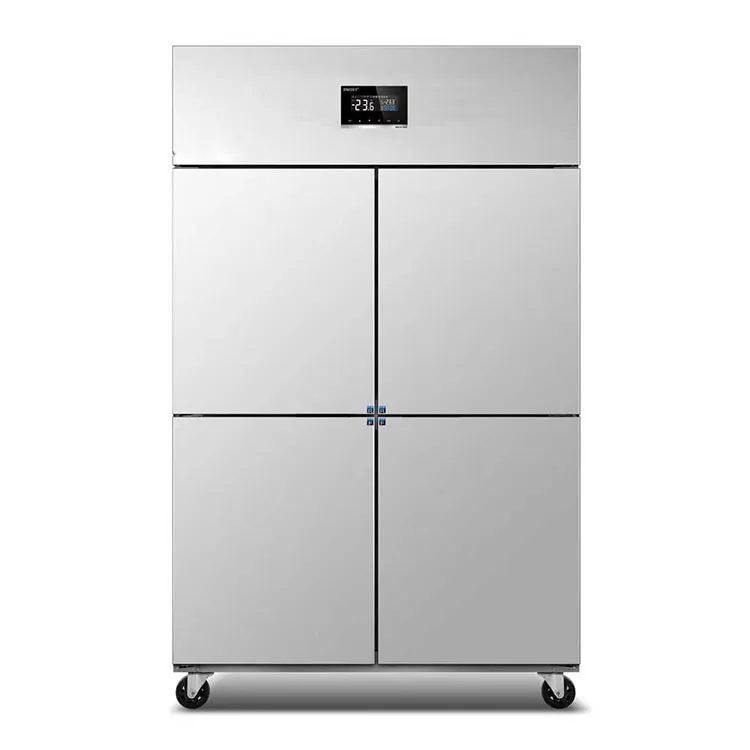
A distributor buying a container of cabinets has leverage at exactly one moment, and it is before the order is confirmed.
Senlis tests every unit for cooling stability, energy efficiency and noise level before shipment, and production runs under ISO 9001 managed processes through a fixed sequence: laser cutting, stainless steel bending, laser welding, surface polishing, quality inspection, then cleaning and packing.
The line covers five model codes — SLS-BFC01, SLS-BFS01, SLS-BZC01, SLS-BZD01 and SLS-BZS01 — in 2-door, 4-door and 6-door configurations.
| Parameter | Specification |
| Temperature | Chill 2–8 °C · Freeze −18–0 °C · Dual-temperature versions |
| Refrigerant | R600 (chill) · R290 (freeze) |
| Volume options | 900 L · 920 L · 1400 L · 1420 L |
| External dimensions | 1200 × 700 × 1920 mm · 1820 × 700 × 1920 mm |
| Cooling | Copper-tube cooling with 360° frost-free air circulation |
| Shelving | Reinforced adjustable shelves rated to 400 kg; galvanized load-bearing shelves |
| Doors | Auto-rebound doors |
| Lighting | LED |
| Certification | CE, RoHS, ISO 9001 |
Both refrigerants used across this line are natural, which places it on the correct side of the transition described below. Voltage (110 V / 220 V / 380 V), plug standard, exterior finish, branding, internal layout and manual language are OEM options.
IEC 60335-2-89 covers safety for commercial refrigerating appliances, including charge limits for flammable natural refrigerants. Those limits are the reason a hydrocarbon-charged cabinet of a given volume is engineered the way it is.
The EU F-Gas Regulation and, globally, the Kigali Amendment to the Montreal Protocol set the HFC phase-down schedule that UNEP OzonAction tracks. For a buyer, the practical reading is straightforward: a cabinet’s serviceable life is bounded by whether its refrigerant will still be available and legal to handle in that market a decade from now.
ASHRAE publishes the refrigerant safety classifications both frameworks reference, and the EU Ecodesign and Energy Labelling Regulations for professional refrigeration (2015/1095 and 2019/2018) define the conditions under which performance is declared.
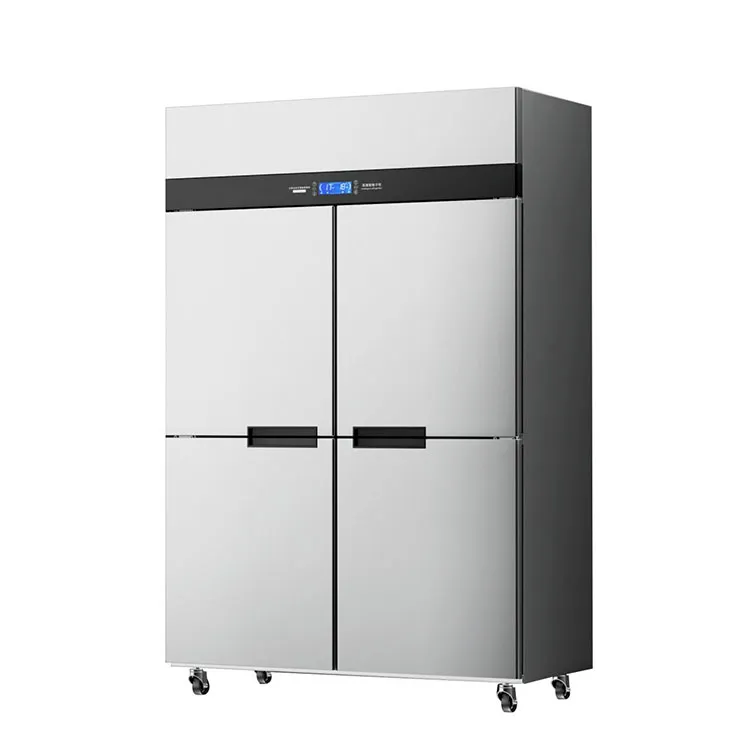
Heavier cabinet construction and reinforced shelving add weight, and weight is freight cost on every unit in the container. For a distributor moving volume into a price-sensitive market, that is a real margin question rather than a rounding error.
Hydrocarbon refrigerants carry charge limits, which constrains how large a single refrigeration circuit can be. This is why very large cabinets sometimes use multiple circuits, adding components that can themselves fail.
And accessible condensers usually mean a service panel or a front-breathing design, which occupies footprint that could otherwise have been internal volume. A cabinet optimised purely for litres per square metre of floor tends to be the one nobody can service.
Pricing is quoted per project — request a quote for your model, quantity and destination market.
A: Ten to fifteen years in normal service. Cabinets that reach the upper end are usually ones where the gasket was replaced on schedule, the condenser was reachable, and the doors closed themselves.
A: It is built for a different duty cycle — far more door openings, higher ambient temperatures and continuous loading — so the comparison is not directly meaningful. A domestic unit placed in commercial service will not reach either figure.
A: Economics rather than mechanics. The decision point is typically the second or third significant repair within a year, or a compressor failure on a cabinet already past ten years.
A: Technically yes. Whether it is worth doing depends on the cabinet’s age, whether the insulation is still dry, and whether the refrigerant can still be sourced legally in that market.
A: It affects serviceable life rather than mechanical life. Natural refrigerants such as R290 and R600 are not subject to HFC phase-down schedules, so servicing availability is not capped by a regulatory deadline.
A: It removes one compounding failure path. Frost buildup on the evaporator lengthens run time, and sustained run time is what ages a compressor. Continuous air circulation prevents that accumulation.
A: Frequency depends on how greasy and dusty the room is; a fryer-adjacent kitchen fouls a condenser far faster than a retail backroom. The more useful question at purchase is whether cleaning it takes two minutes or twenty.
A: Gaskets first, then door hinges and closers, then evaporator fan motors and shelf clips. These cover the majority of failures that would otherwise take a cabinet out of service.
2026-10
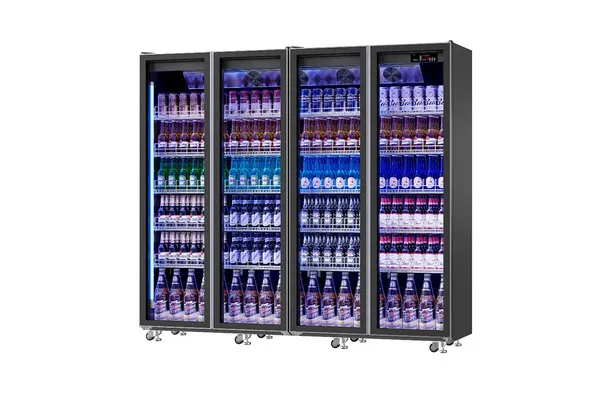
Compare bar coolers, back bar and undercounter designs, beer temperature needs, glass door…
2026-09
The SLS-ZD1860 Combo Island Cabinet measures 1860 × 810 × 800 mm and lists a temperature r…
We will reply you within 24 hours. If for urgent case, please add WhatsApp/WeChat: +8617806295551. Or call +8617806295551/+8617660987312 directly.
*We respect your confidentiality and all information are protected.
We will only use your information to respond to your inquiry and will never send unsolicited emails or promotional messages.